

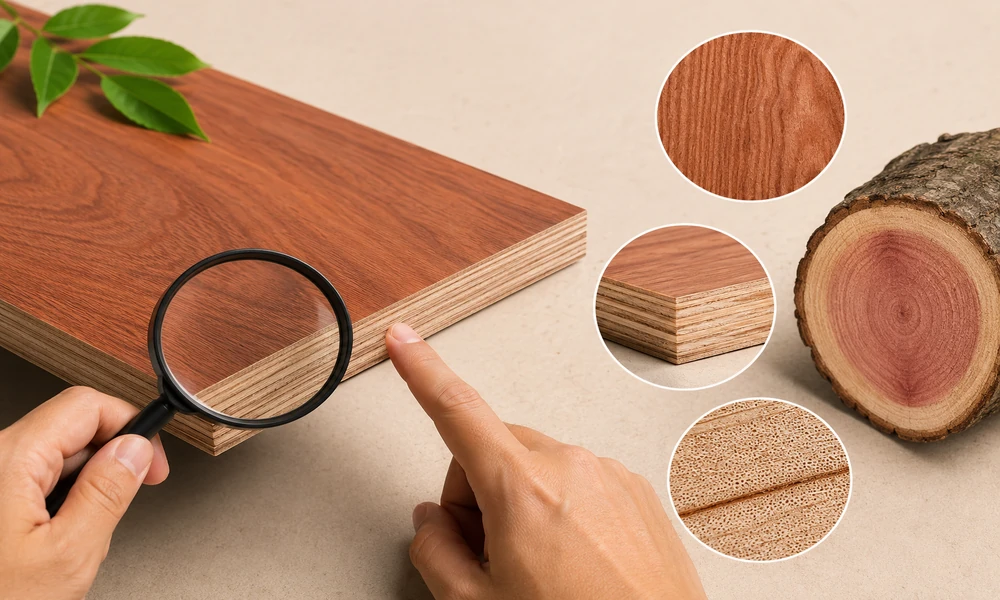
Gurjan wood is appreciated for its manufacturing properties, durability, and ability to be used for demanding applications. However, determining if a piece of wood is made of Gurjan can be very challenging if it is already manufactured into veneers and plywood.
If you want to buy Gurjan plywood, it is important to get acquainted with the things that need to be checked to avoid relying only on the product description of the sale.
Check the Label and Classification of the Product
The first thing to do is to check the plywood sheet for the manufacturer’s marks, details, grade, thickness, and compliance with standards. If the plywood is labelled as Gurjan plywood or Gurjan-faced plywood, then it should be indicated what this terminology implies.
This is important because it is possible to have a product made of Gurjan veneer only on top of the sheet, while the inside is made of other types of wood. Hence, the term Gurjan face does not mean that Gurjan wood was used in all the layers of plywood.
Look at the Face Veneer
Gurjan veneer does have a very specific appearance, but one cannot rely on it completely since the appearance does not guarantee the identification of the type of wood. Grain pattern, colour, texture, and differences can vary due to the tree itself. Instead of relying on a specific colour or grain pattern, seek a uniform natural veneer. A glossy or laminated surface could make visual detection more challenging.
Check the Plywood Edges
The edges of the plywood will allow a better peek at the internal structure. Check the arrangement, thickness, and quality of the individual veneer layers.
If it is claimed to be Gurjan-core plywood, a producer should be able to introduce the wood that was used to manufacture the core. However, one can never really know the exact type of timber when looking at the edges only.
If you see too many gaps, too many hollow spaces in the core, unevenly arranged layers, or poor adhesion (whatever the wood types are) – this means that the quality is low.
Manufacturers Specifications
To be considered safe when making a purchase, a client should refer to the vendor or producer for specifications and documents. The information about the wood species, the construction of the plywood, its class, standards, purpose, etc. is more trustworthy than visual estimation only.
If a seller’s claim is that the plywood consists of 100% Gurjan wood, a client may ask if he/she means Gurjan face veneer, Gurjan used for all layers, or the specific plywood product that may refer to Gurjan wood.
A good producer will provide a clear explanation. The weight of wood can change depending on its species, moisture, thickness, density, and making process.
Although wood colour cannot serve as an absolutely accurate identification factor,r as different veneers may share the same colour and grain features, surface treatment gives each veneer a different characteristic.
So, the grain pattern, weight, and colour have to be treated as indicators rather than proofs of wood identification.
Examine the Core for Quality
Determining wood species is extremely important, but it is also important to inspect the overall quality of plywood manufacture.
A good-quality plywood sheet shall be made of layers bonded together with few voids, meaning it has to be constructed properly.
Do a visual examination of the edges for visible gaps, overlapping veneers, peeling manufacturer’s layers, or evidence of delamination.
Also, take wood thickness, dimensional stability, resistance to moisture, and appropriateness for the planned use into account.
Checking the presence of Gurjan veneer does not guarantee that this plywood sheet has good quality.
Use Independent Verification when Appropriate
In case the project involves costly operations or has technical requirements concerning the wood species, the visual examination and verbal confirmation from the vendor are not enough.
Independent laboratory or technical tests could provide a more accurate result concerning the wood species or composition.
In particular, if large quantities are going to be purchased, the need for any specifications must be analysed in advance.
Conclusion
In conclusion, it is impossible to tell whether plywood is made from Gurjan wood just by looking at its colour or grain appearance.
To check this out, get the description of the plywood straight from the manufacturer, and try to find out whether it is a Gurjan face veneer or Gurjan plywood and check the plywood manufacturing process as well.
